
Shelves and starlight
Observing Giorgio Morandi's still lifes

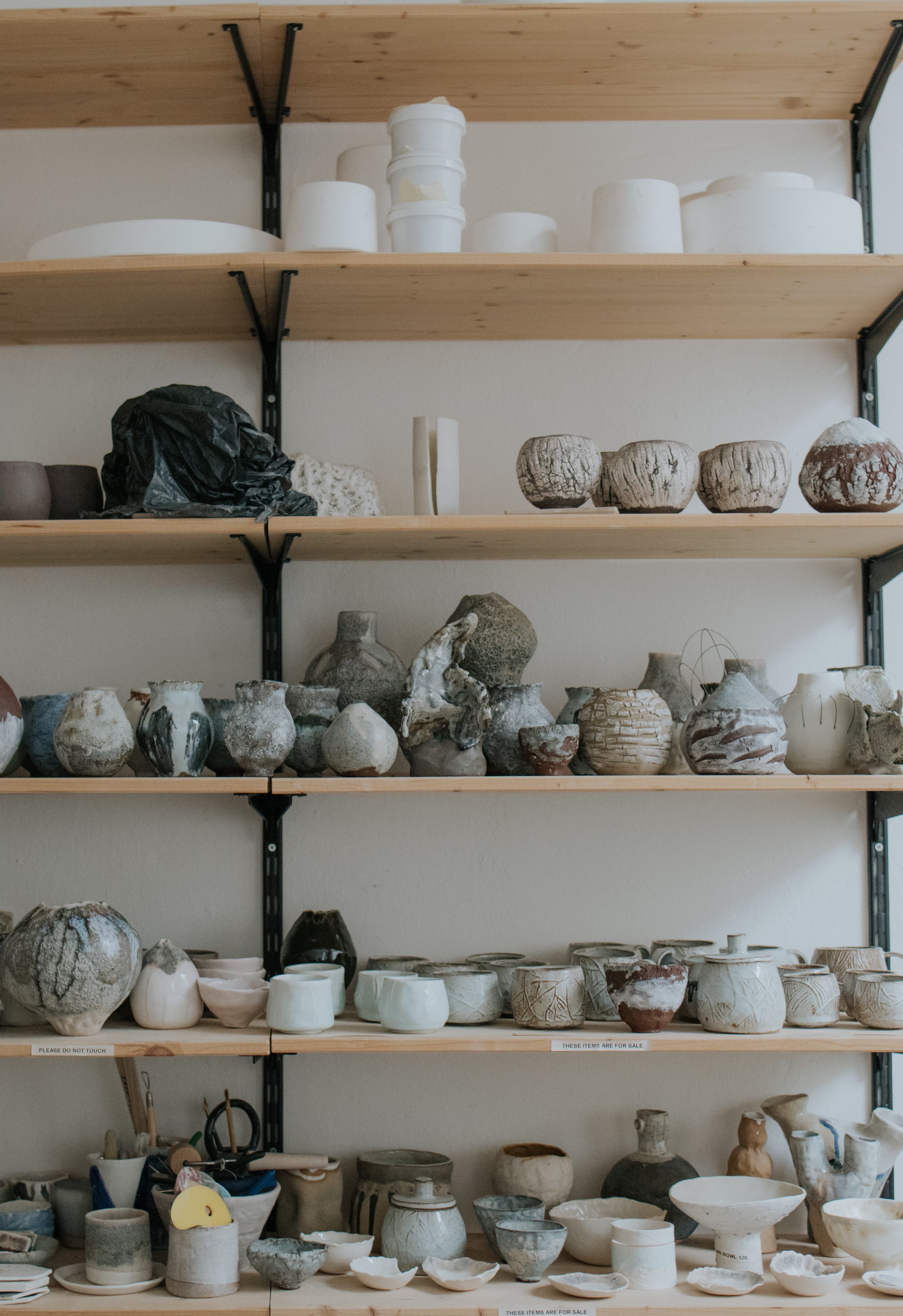
It is Monday and I am in the studio. A warm afternoon light casts a spotlight on the floor-to-ceiling shelves. A few people walk by and look inside the room through the big window, hands like a visor, shielding their eyes from the reflection. They study the vases sitting in front of them, then move their gaze sideways and upwards, towards the shelves.
I am idle. Unable to start something new, resigned to staring at my past work, hoping for answers or epiphanies. Working with clay means entering in conversation with the past. Clay itself represents the past - erosion that created minerals that we mix together to make a malleable paste. But the act of creating something out of clay is an exercise in memory and repetition.
If making is remembering, then a shelf full of work is a museum holding past versions of the maker. There are cups and vases clumped together, unorganized, like trees in a forest, placed at random. I do not remember the intention behind the placement of these objects.
I am reminded of Giorgio Morandi’s still lifes. Morandi (1890–1964) spent most of his time in his studio in Bologna and is well known for his carefully composed paintings featuring vases, bottles and pots. He spent a long time arranging the subjects of his works, even sketching their outlines on the table in order to mark their future placement. He then painted quickly, as if the whole point of the exercise consisted of immortalizing a certain arrangement of lines in the right light1.
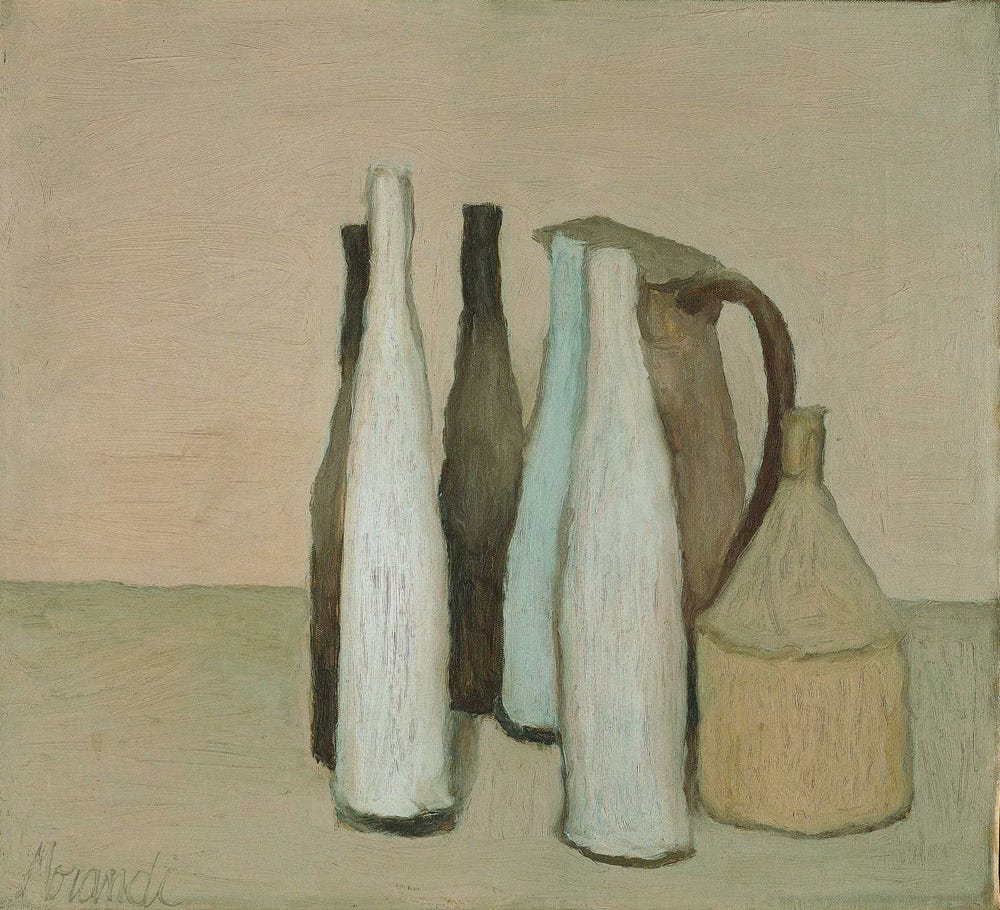
In January of this year, I recorded voice notes and wrote journal entries while observing two of Morandi’s paintings multiple times over the course of a few days. I found something new during every viewing.
At first I wondered about the objects: why these specific pots? I observed the muted color palette. I then started seeing the lines melt into each other, not knowing where a vase ended and another began. Morandi often worked on variations - painting the same objects in different positions - and thought that such constraints did not constitute a restraint for the artist. I happen to agree. Self-imposed constraints can be incredibly liberating.
On January 2nd 2026, I write:
Morandi’s catalogue is so interesting. Some of the objects in his nature morte look like they blend into each other. I will spend more time with them. I will look more closely. I would like to create work that breathes on its own plane of existence.
On January 4th 2026, I record a voice note and remark that the painting technique has a very light touch, which however does not mean that it is not precise or that it lacks poetry or skill. The handle of the carafe has a gentle curve that meets the side of the smaller vase. I also notice that, as is typical of Morandi, we know that the pots are standing on a surface but we cannot really see perspective or shadows. If we were to draw a shape around the objects, we would draw a rectangle.
I imagine him looking at his past work and re-arranging his pots. “I do not disown anything of my past because I have no failing to hide..”2, he wrote in a short autobiography.
I keep looking because the meaning of his work eludes me. His work is understated yet complex. It was not about the bottles or vases themselves - they were means to an end. He even painted the bottles to prevent reflections. These were not objects dear to him. However, the attempt to find meaning is superfluous. Morandi himself said that he never intended to give the objects a specific meaning and that “matter exists, of course, but has no intrinsic meaning of its own, such as the meanings that we attach to it. We can know only that a cup is a cup, that a tree is a tree.”3
T.J. Clark, says about the meaning of looking at art in his book “The Sight of Death: An Experiment in Art Writing”:
Paul Valery says somewhere that a work of art is defined by the fact that it does not exhaust itself - offer what it has to offer - on first or second or subsequent reading. Art-ness is the capacity to invite repeated response.4
Back in the studio, I shift from observation to action and start moving around a few pots, trying to help them find their place. I place the porcelain tea cups closer to each other. I take a few steps back. If I were to trace a line of their contours, it would be a calm sea, a flat surface. The pots on the shelf above - vases inspired by the moons of Saturn - form an unruly silhouette.
When a vase is made, it does not yet have a place on a shelf. There is never place on a shelf, but the work needs to be made anyway. Eventually pieces leave the studio - finding their collectors - and all I have left from the shadow they were casting is a thin layer of dust on the wooden planks. But I do firmly believe that every piece has its place among the rest. I do not think about where it will go as I make it, but eventually it will have to find its place.
I do not think about it when I make it.
Some time later, however, I will look at it, sitting on a shelf, casting shadows like a star whose light is a message from the distant past. Was I honest when I made it? Was I being rushed by the will to finish, to be done with it? The true nature of a piece is only revealed when you catch a glimpse of it from afar. You raise your head from a mundane task and encounter it, there, not demanding, not open or closed, its boundaries vibrating.
On Morandi’s life and work, see Museo Morandi “Catalogo generale”, Silvana Editore, 2025
In Karen Wilkin, “Giorgio Morandi: Works, Writings, Interviews” ACC Art Books - IPSUK, 2024
ibid
T. J. Clark, “The Sight of Death: An Experiment in Art Writing”, Yale University Press, 2008, p.115